Exhibits
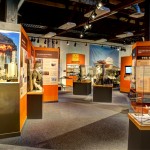
The Texas Military Forces Museum is the only museum in the nation that presents the history of the Texas Military from the Texas Revolution to the present. Exhibits currently on display include:
Texas Revolution – A diorama of the final assault on the Alamo, March 6, 1836, is depicted along with replicas of the Twin Sisters cannons used in the Battle of San Jacinto. A diorama of the Battle of San Jacinto, the battle in which Texas won its independence from Mexico on April 21, 1836, and an exhibit of the ten battle flags of Texas are presented as well as information on William B. Travis, Sam Houston, Juan Seguin, General Santa Ana and Stephen F. Austin. On display is a replica of the Mexican cannon captured by the Texans at San Jacinto, along with a “soldado Mexicano” resplendent in 1835 field uniform. The role of the African-Americans in the Texas Revolution is also depicted along with artifacts from the battlefields of that war.
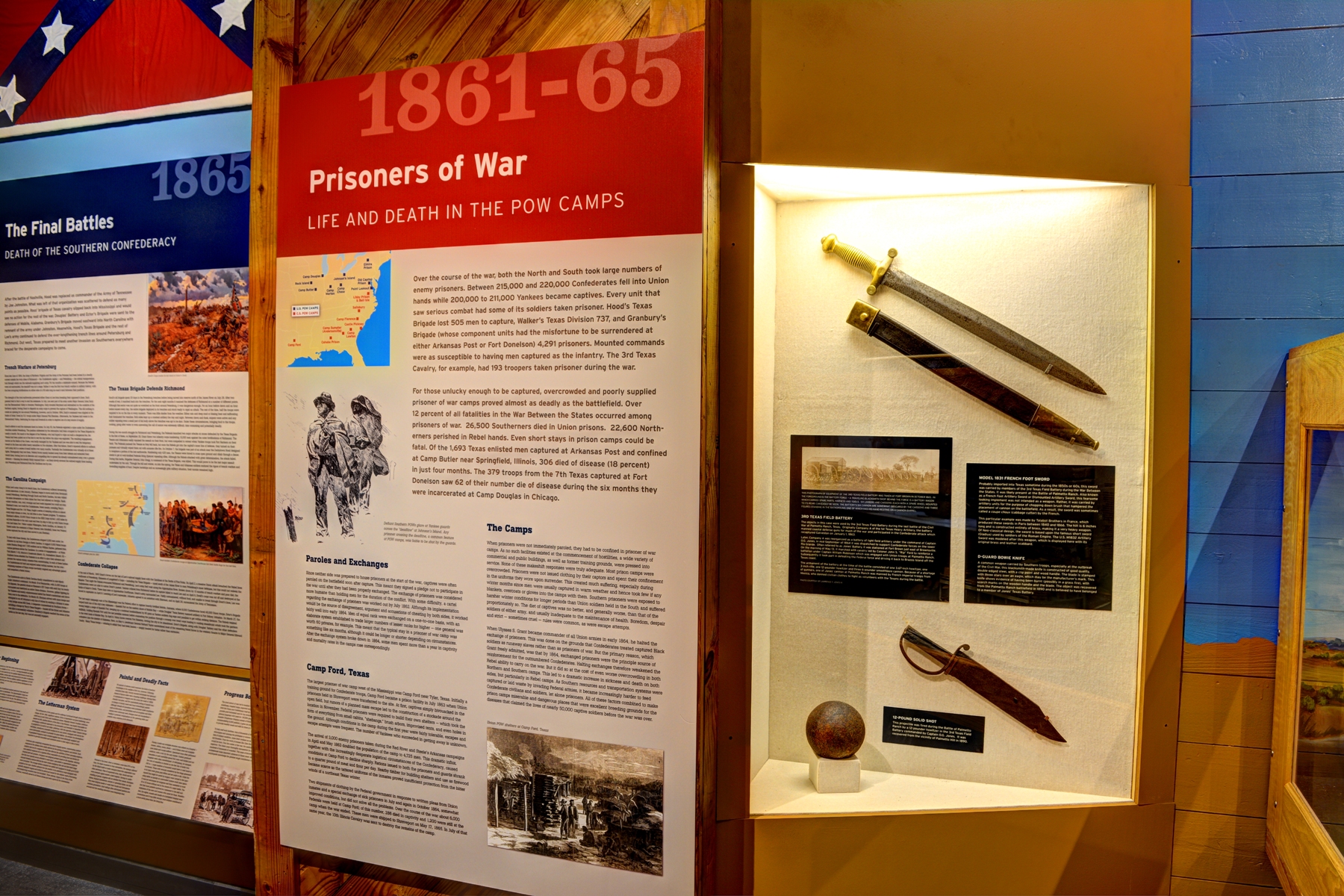
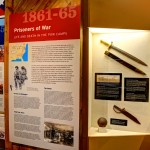
War Between the States - An exhibit depicting the role of Texas in the War Between the States is presented by pictures, uniforms, weapons and biographies of various confederate officers who had distinct ties to the Lone Star State during that period of time. Flags of the 10th Cavalry are on display, along with mannequins dressed in period uniforms with equipment. In addition, state flags of the Confederate States as they were in 1867 are displayed as well as a diorama depicting the Charge of the Texas Brigade at the Battle of the Wilderness, May 6, 1864, in Virginia.

Battle of Palmetto Ranch: 12 - 13 May 1865
Buffalo Soldiers - Called the “Buffalo Soldiers” by their adversaries, the U.S. 9th and 10th Cavalry were stationed at different times on the Texas frontier during the Post Civil War Period. They bravely protected citizens from Indian and bandit depredations and attempted to maintain law and order. The 9th Cavalry was in Texas first before being replaced by the 10th. During World War II, the 9th Cavalry became a part of the 56th Cavalry Brigade when the 112th Cavalry was sent overseas to the Pacific Theater.
Spanish-American War - Shown in our exhibit are weapons and uniforms of the period and a roster of a company of one of the regiments raised in Texas to fight in the war. None of the regiments fought, but one performed occupation duty in Cuba. Of particular note is a write-up and a pistol that belonged to Captain William Walker, Commander of Troop G, 1st Texas Volunteer Cavalry. Part of this exhibit is an 1897 Colt-Marlin machine gun. which was the first machine gun adopted by the U.S. Armed Forces.
World War I - Memorabilia, photographs, uniforms and equipment of soldiers who served in the 36th Infantry Division and 90th Infantry Division are displayed. The 36th Division was born with the mobilization of the Texas and Oklahoma National Guard for World War I in 1917. The Division formed at Camp Bowie in Fort Worth and fought in the Meuse-Argonne offensive in France in the “Great War.” Highlighting this exhibit is a diorama of the Battle of St. Entienne in France in 1918 in which the 36th Division played a major role. The 90th Division was formed at Camp Travis in San Antonio and consisted of draftees from Texas and Oklahoma.
Between the Wars - After World War I, the 36th Division was formed entirely in Texas and, along with the 56th Cavalry Brigade, constituted the Texas National Guard. The Cavalry Brigade was not part of the 36th Division and consisted of the 112th and 124th Cavalry Regiments, which were horse mounted. Pictures and memorabilia tell the story of this time period.
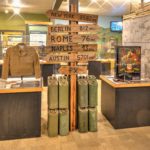
World War II - A major portion of the exhibits in the museum detail the story of the 36th “Texas” Infantry Division, the 112th and 124th Cavalry Regiments, the 111th Observation Squadron and the Texas Defense Guard. Texas National Guard units fought in Europe, Burma and the Pacific, while the Texas Defense Guard organized 50 battalions to guard Texas against invasion and sabotage. American, captured German, Japanese and Italian equipment and weapons are included in the exhibit.
The Lost Battalion - The 2nd Battalion, 131st Field Artillery, part of the 36th Division, was detached from the Division in 1942 and sent to Java in the Dutch East Indies. When the Dutch surrendered to the Japanese, the Battalion went into captivity for 42 months. The prisoners of war worked on the “Death Railway” in Thailand, of which the bridge over the River Kwai was a part, and in the mines in Manchuria and Japan until they were released when the Japanese surrendered. Prisoners off the sunken cruiser, USS Houston, were also a part of the group. The trials and tribulations of the POWs are the subject of this exhibit.
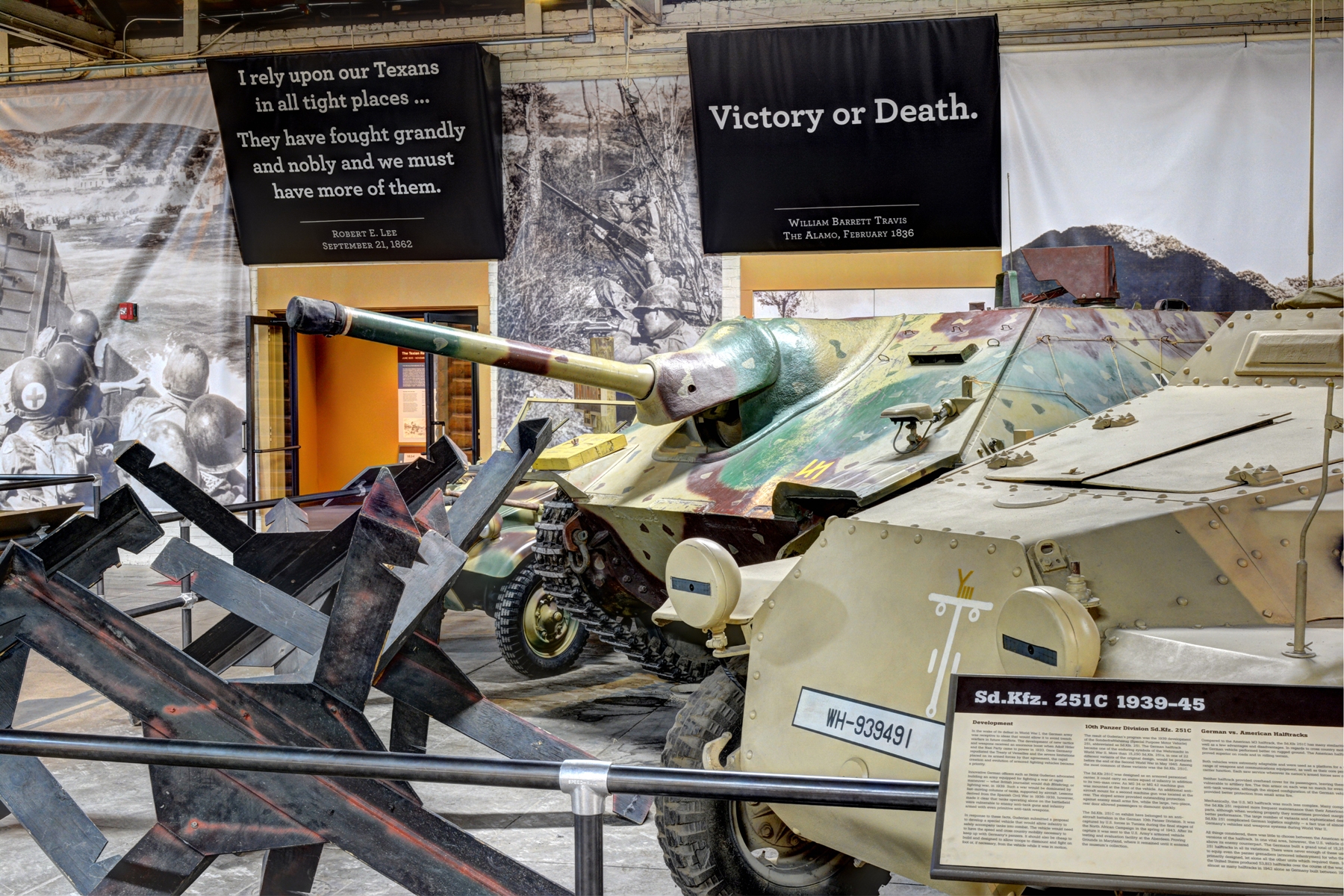
Captured Enemy Equipment - Weapons and equipment that belonged to German, Italian, Japanese, North Vietnamese and Iraqi troops seized during the various conflicts are displayed. Included are rifles, pistols, swords, flags, machine guns, recoilless rifles, rocket launchers, antitank rifles and mortars used against Texas troops.
History of Military Aviation - The history of U.S. military aviation is depicted using model aircraft in 1/72 scale. The collection begins with the military version of the Wright Flyer and contains various landmark aircraft developed by the United States military through the years.
Weapons Display - In Room 2 of the main gallery there are, on display,
various weapons used by Germany, Japan, Italy, Austria, France, England and the United States during World War I. Also on display are weapons used by the Allies and the Axis during World War II and weapons used during the Vietnam War, the Korean War and the most recent wars in Afghanistan and Iraq. Individual as well as crew-served weapons are on exhibit.
Korean Conflict -Practically the entire Texas Air National Guard was called to active duty for the Korean Conflict. Combat missions were flown in the skies over Korea in “MIG” Alley.
Vietnam War - Although no Texas National Guard units fought in the Vietnam Conflict, many members of today’s Texas Guard are Veterans of that Conflict. The Texas Air National Guard flew “short tours,” support missions hauling cargo. The Texas Army National Guard was tasked to form a separate infantry brigade for intensified training for possible deployment. For two and one half years, the 36th Infantry Brigade, made up mostly of units from the 36th Division, conducted intensified training. It was ranked as one of the best National Guard Brigades in the country when the decision was made by President Lyndon Johnson not to mobilize the National Guard for the Vietnam Conflict.
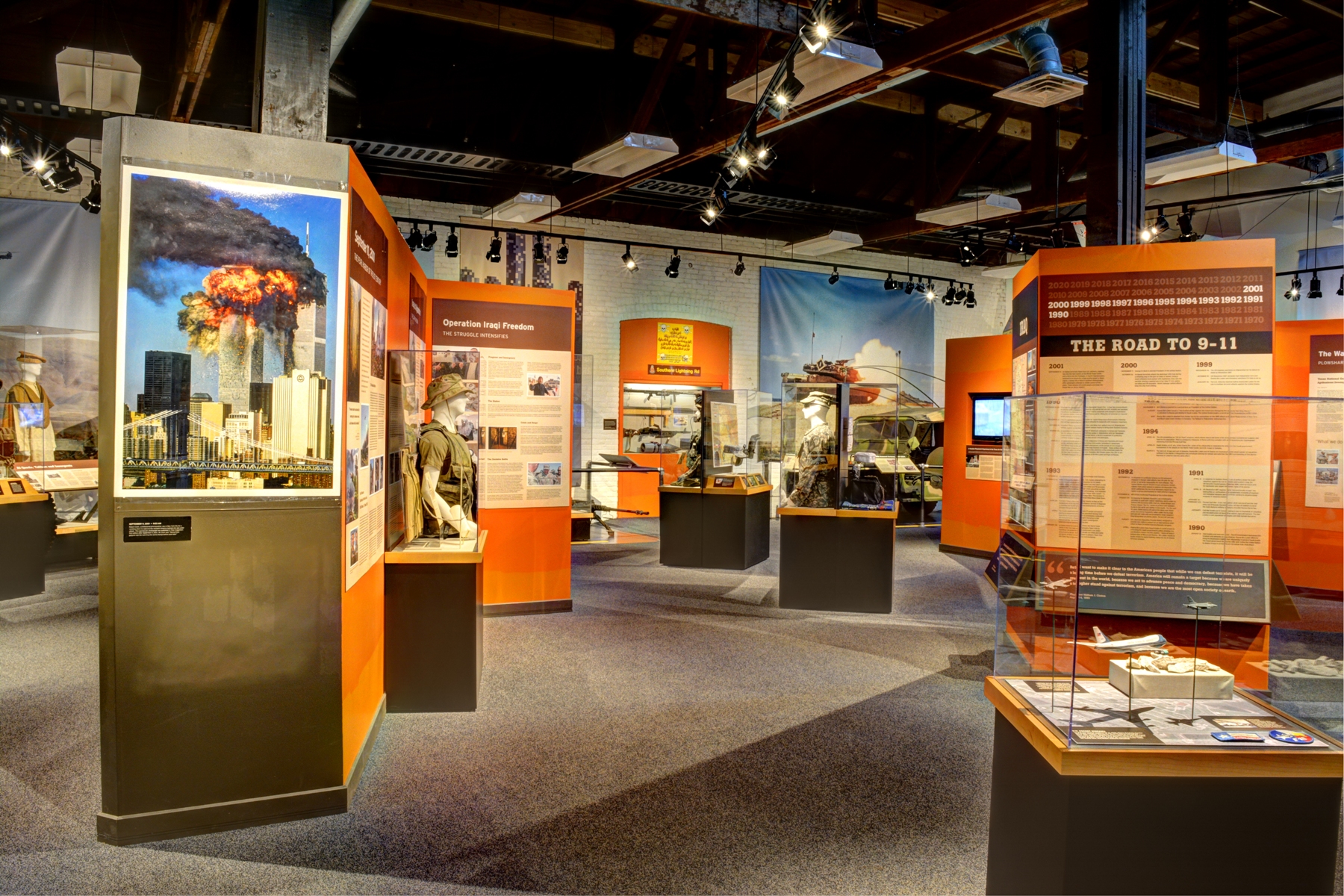
The Gulf War - Twenty-five Texas Army and Air National Guard units were mobilized for Desert Shield/Desert Storm. Four Army Guard units were deployed to the Middle East and the 136th Military Airlift Wing provided in-country support, flying the C-130 aircraft. Numerous Air Guard personnel also served in the war on an individual basis. Exhibited are items of equipment captured from the Iraqi Armed Forces by the 49th Air Traffic Control Platoon and Company G, 149th Aviation.
History of the 49th Armored Division - Formed after World War II, the 49th “Lone Star” Armored Division was one of the first Armored Divisions formed in the National Guard. It was mobilized for the Berlin Crisis in 1961 and sent to Fort Polk, Louisiana. The division had a Cold War mission of deploying to Germany in the event of a war with the Soviet Bloc. On 1 May 2004, the 49th was converted to the 36th Infantry Division. Pictures, uniforms, models, maps and descriptions of historical events tell the story of the Division.
The Texas Cavalry exhibit shows the development of the Texas Cavalry as it converted from horses to tanks. It consists of a blacksmith shop, two mounted Texas Cavalrymen, swords, flags of the 112th and 124th Cavalry Regiments, guidons and scale model tanks. The development of the tank is depicted by models of American, German and Japanese tanks. Two horse-mounted cavalymen depict the spirit of the Texas Cavalry.
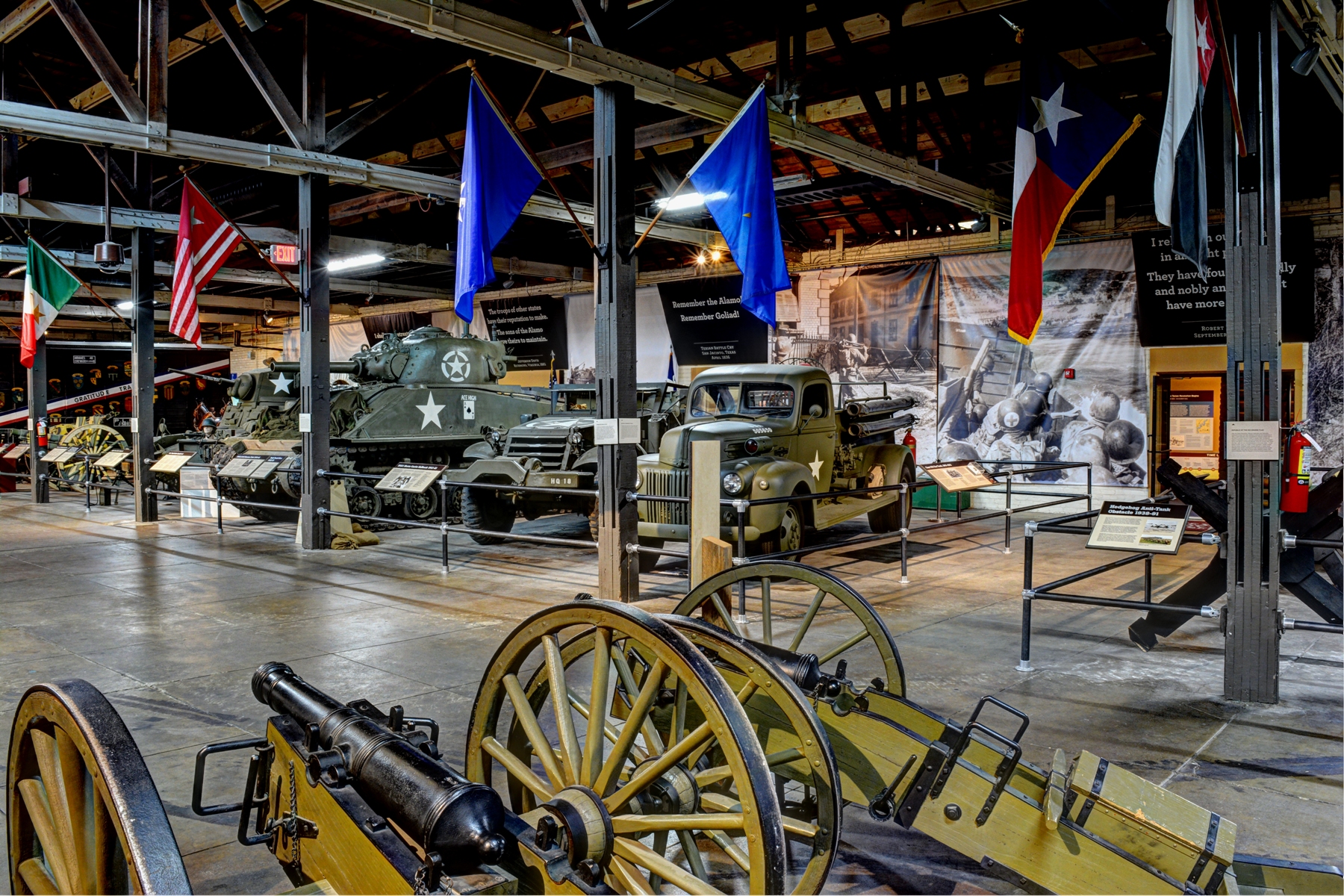
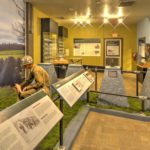
The Great Hall Inside the large exhibit hall is a vast array of artifacts: The M4A3 “Sherman” tank of World War II; the German “Hetzer” tank destroyer of World War II (one of four in the United States); an OH-58 Observation Helicopter and OH-23 Helicopter; the World War II “Grasshopper” light airplane; a paratrooper from the 71st Airborne Brigade; the complete family of the famous Jeeps; a complete Air Force Mobile Radio Relay Station; an Army Escort Wagon; an artillery position representing the Texas Artillery in the Pacific during World War II; a World War II amphibious truck (DUKW) and numerous other large pieces of equipment from the Cold War and World War II. A World War II M3A1 “Stuart” tank and a 75mm gun of the type used by the Lost Battalion are included as well as an F-16 Cockpit Egress Trainer. New exhibits are Dime Store Soldiers, Axis antiaircraft guns, the Home Front and a diorama of the First Capital of Texas located in Austin.
The Texas Hall of Heroes is a special exhibit honoring Texans who have received the Medal of Honor. Large replicas of the Army, Navy and Air Force Medals of Honor as well as the Texas Legislative Medal of Honor are mounted on the walls. Pictures and the citations of all Texas Medal of Honor recipients are on display.
Peace in the Balkans - This exhibit consists of memorabilia pertaining to the deployment of Texas National Guard troops to the Balkans in order to maintain peace in that area of the world. It includes the recent deployment of the Headquarters of the 49th Armored Division as the command element for the U.S. controlled sector in Bosnia.
Special Exhibits
- The Battle of San Jacinto (Diorama)
- The Mier Expedition (white bean – black bean)
- The Battle of Sabine Pass (Diorama)
- Field Marshall Rommel’s Boots and Cap
- National Guard Presidential Exhibit
- The Army Field Kitchen
- What The Soldier Wore (Field Display)
- What the Soldiers Ate
- Women in the Military
Outdoor Exhibits - Located on the South and West side of Building 6 and along the North and East sides of the parade field are numerous displays of armor, artillery and aircraft. On the South side of Building 6 is Armor Row. This exhibit features a collection of tanks, armored personnel carriers and specialized vehicles,. The tank collection consists of an M-24 “Chaffee,” an M-26 “Pershing,” an M-47 “Patton,” the M-60 series of tanks and an early model M-1 “Abrams.” The personnel carriers consist of the early model M-75, an M-59, an M-84 and the M-113 series. Specializing equipment consists of an M-42 "Duster," a Combat Engineer Vehicle, an Armored Recovery Vehicle (“Snoopy”), an Engineer Bulldozer and a Cement Truck. A Soviet-made Iraqi armored ambulance and a number of U.S. self-propelled artillery pieces round out the collection. A new outdoor exhibit has been established in Building 7, just west of Building 6. Building 7 contains towed artillery pieces which include American, German, French and Russian. This completes the Artillery Park. On the North side of the parade ground is a Russian-made 130mm gun taken from Iraq and delivered to the museum by Company G, 149th Aviation as a result of the Gulf War. On the East side of the parade field are three helicopters flown by the Texas Army National Guard which include the “COBRA” gunship and a UH-IM, the first gunships used during the Vietnam War. An F-4 “Phantom” and an F-86 “Sabre Jet,” flown by the Texas Air National Guard during the Vietnam War and the Korean War respectively, round out the displays.
![]() |
||
![]() |
![]() |
![]() |
![]() |
![]() |
![]() |
Texas Air National Guard - The Texas Air National Guard began when the 111th Observation Squadron, which was part of the 36th Division, split from the Division in 1942. Personnel were transferred to the Army Air Corps and fought in North Africa, Italy and Central Europe. Today’s Texas Air National Guard flies F-16 and C-130 aircraft from three flying bases and has units engaged in mobile communications, electronics installation, weather and security at seven separate locations in the state.
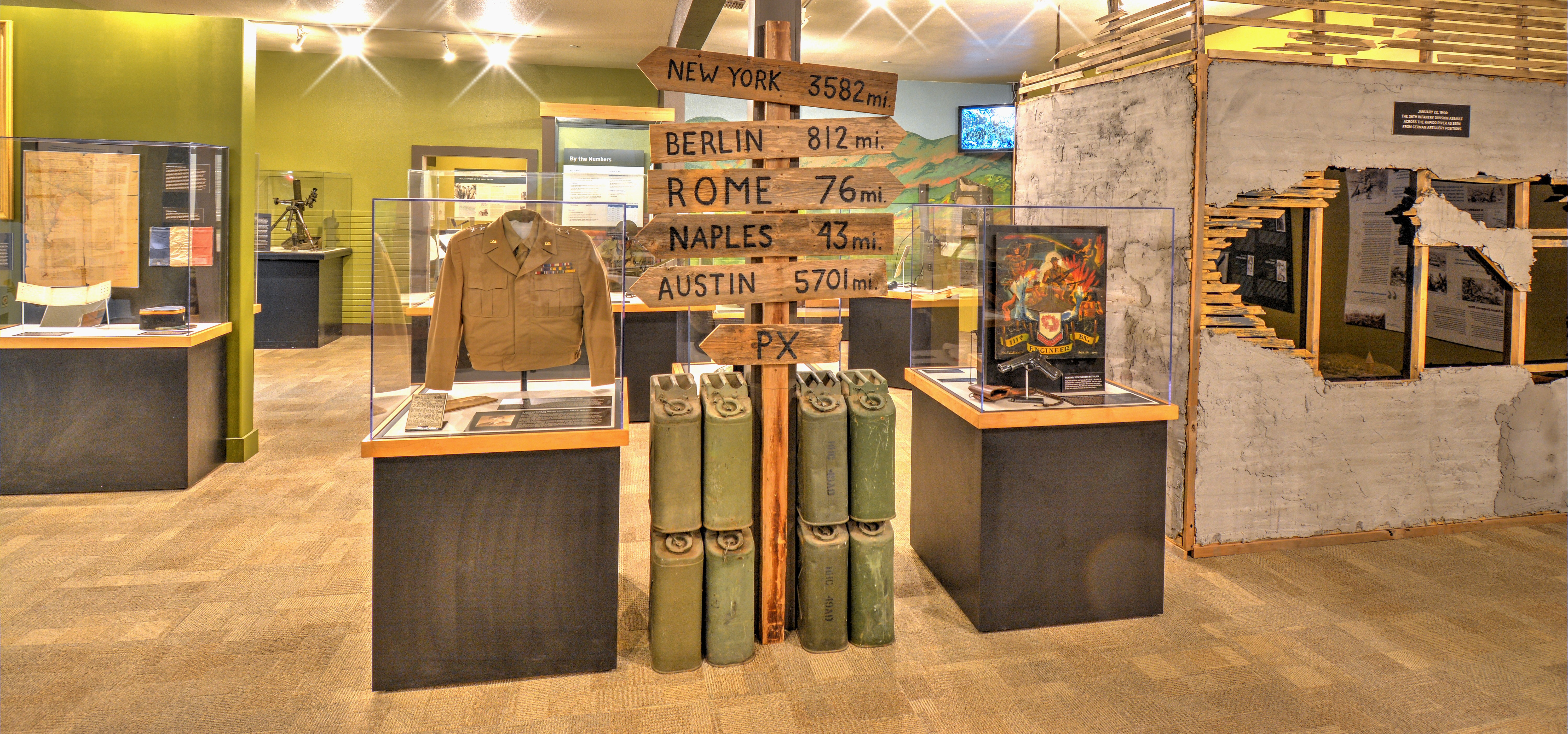
The 36th "Texas" Infantry Division - This exhibit, located on the east side of the building, depicts the history of the “Texas Division” from the time it was organized in 1917 until its deactivation in January 1968. (The Division was reactivated 1 May 2004.)
Originally organized by merging the Texas and Oklahoma National Guards at Camp Bowie in Fort Worth, the Division fought in the Meuse-Argonne Campaign in World War I. The Division insignia was approved in 1919, and consisted of an Arrowhead, signifying Oklahoma, with a superimposed "T" for Texas. When the Division was called to active Federal service on November 25, 1940, it was an “all Texas” Division. It initially trained at Camp Bowie and Brownwood and other locations before being shipped overseas. It was the first American combat division to go ashore in Europe when it landed at Salerno, Italy, in September 1943. The 36th fought in seven campaigns: Naples-Foggia, Anzio, Rome-Arno, Southern France, Rhineland, Ardennes-Alsace and central Europe. It was credited with two assault landings and won the French Croix de Guerre with palm, embroidered VOSGES.
After the war the division conducted training and participated in numerous natural disasters providing aid to civil authorities and to the citizens of Texas. It was deactivated on January 15, 1968 as part of the Army’s program to reduce the number of combat divisions. After the deactivation, the lineage of the 36th was carried on by the 71st Infantry Brigade (Airborne) and later by the 36th Brigade, 49th Armored Division.
Special attractions in the gallery include pictures of members of the 36th in World War II along with books, listing by State, all individuals who served in the Division during World War II.
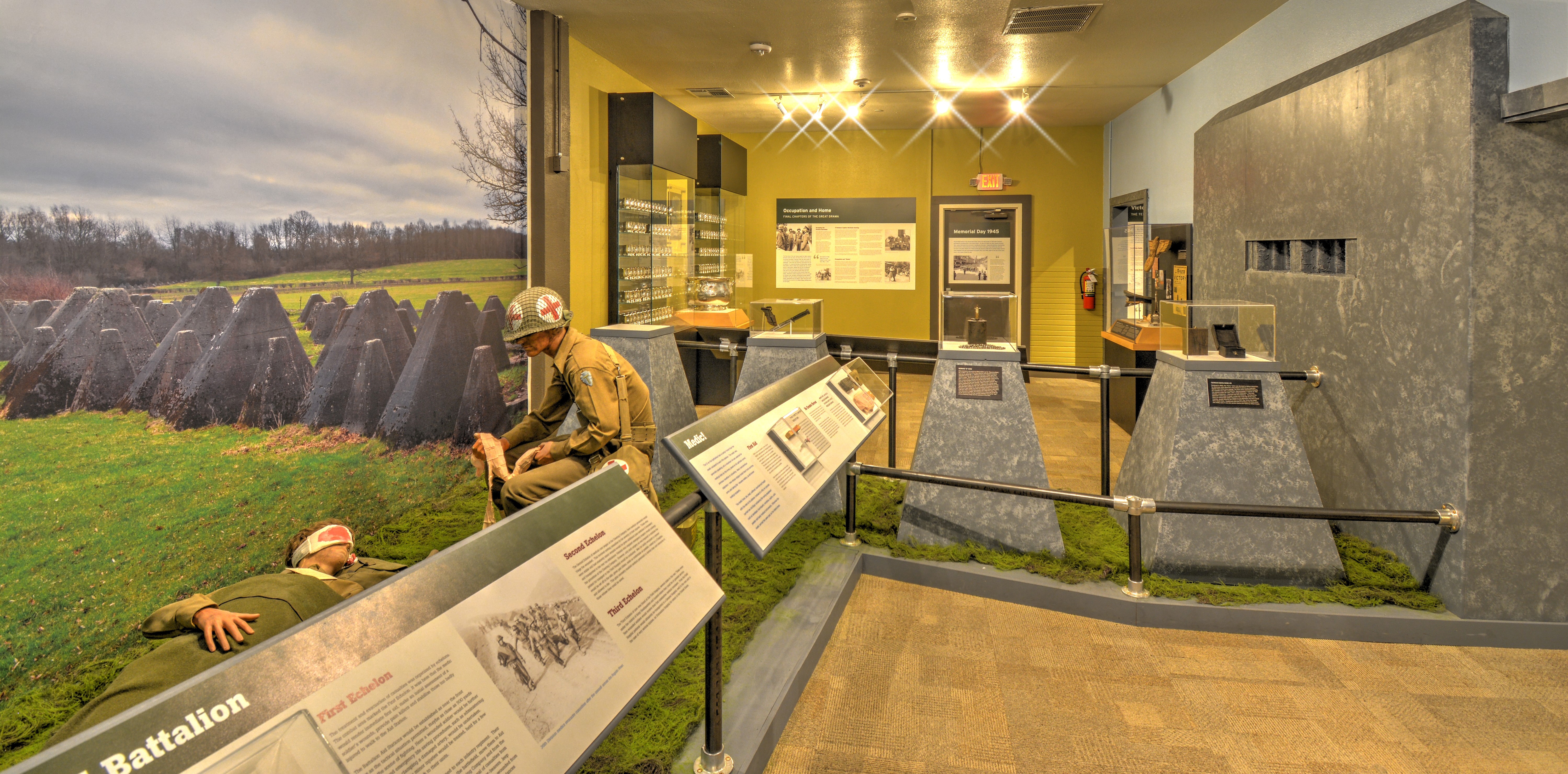
Dioramas include the Landing at Salerno, the Rapido River Crossing and the Battle of Velletri. The Regimental silver of the 142d Infantry Regiment is displayed along with a vignette of a 36th Division GI chowing down in
Italy and an aid man tending to a wounded soldier. Special items include American, German, Italian, French and British weapons and equipment. A special portion of the gallery honors units that were attached to the Division during World War II, including the 442d Regimental Combat Team, the 443d Antiaircraft Battalion, the 636th Tank Destroyer Battalion, the 753d Tank Battalion and the 83d Chemical Company. Of special interest is the small chapel dedicated to the men of the 36th who gave their lives fighting for their country in World Wars I and II.
On 1 May 2004, the 49th Armored Division was deactivated and the 36th Infantry Division took its place in the troop structure of the state. This opens a new chapter in the long and glorious history of the Division.
Library Archives and Flag Repository - The museum maintains a library of military history publications of over 10,000 books. The collection is growing every day with donations from the public and issues from the Department of the Army and Air Force. The library is normally op[en three days a week and is available for in-house research. Archival papers are maintained which include the official card file on those who entered the service in Texas for World War I. Papers belonging to individuals on a “by collection” basis are also maintained. An extensive Field and Technical Manual library is also maintained. There are over 300 historical flags, colors and guidons stored, and in some cases, awaiting restoration. These items belonged to units of the State Military Forces. Many are on exhibit, but there are still a large number awaiting restoration or an appropriate exhibit.. Six hundred maps, 250 collections and over 4,000 photographs are cataloged. Please call 782-5911 for research appointment.
Acquisition of Artifacts - There are two sources of artifacts for our museum. Principally, they are acquired through the U.S. Army Center of Military History, the rest are through donations. We especially encourage the donations of private collections by former members of the Army and Air National Guard, the Texas State Guard and the active military forces. Contact the Museum Registrar, Lisa Sharik, at 512-782-5394, for information.
Join the Museum - Join us in preserving the history of the Texas Military Forces by becoming a member of our museum. We depend upon donations and volunteers to operate. There is no admission fee and group tours, especially students, are welcomed. Presently, we are open to the public five days a week, but with additional volunteers we hope to expand our hours.